Same Team, Different Game: How Japanese Co-op Design Is Making American Players Actually Like Each Other Again
Open a random American gaming forum on any given Tuesday and you'll find the same conversation happening in a dozen threads: someone got screamed at in a ranked match, someone quit a team game because a stranger made it miserable, someone is swearing off multiplayer entirely. It's almost a ritual at this point.
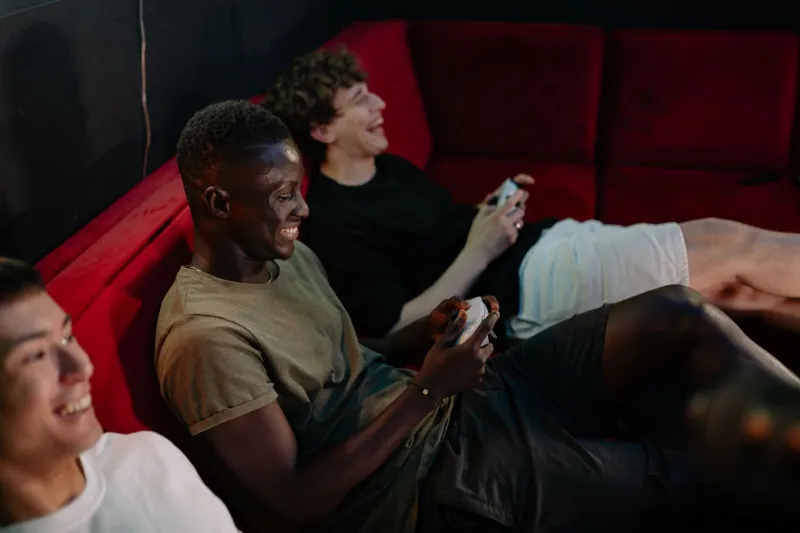
But scroll a little further and you'll notice a quieter thread running underneath all that noise. Players talking about a Monster Hunter session that ran three hours longer than planned because nobody wanted to leave. A Splatoon squad that kept each other laughing through a losing streak. A Dragon Quest XI co-op run where the whole point was just seeing the story together.
Those aren't accidents. They're the product of a very deliberate design philosophy that Japan has been refining for a long time — and American players are finally starting to feel the difference.
The Competition Trap
Here's the thing about competitive multiplayer: it works great right up until it doesn't. Rankings, win rates, K/D ratios — these systems are incredibly effective at keeping certain players engaged. But they also create an environment where every loss has a face attached to it, where someone has to be the reason the team failed, where strangers become obstacles instead of companions.
American game design has leaned hard into this model, partly because competition scales. Leaderboards are cheap to build, emotionally potent, and endlessly renewable. There's always another rank to chase.
Japanese studios have certainly made competitive games — the fighting game genre alone is proof of that. But a striking number of Japan's most beloved multiplayer titles are built around a completely different emotional center. The question isn't who's the best. It's what can we do together that we couldn't do alone.
Designed Around the Relationship
Take Monster Hunter, which has quietly become one of the most popular gaming franchises in the US without ever asking you to beat another player. The entire loop is built around shared challenge: a creature that's genuinely hard to take down, a preparation phase that rewards coordination, and a payoff — the reward screen, the new crafting options — that belongs to everyone at the table equally.
There's no internal ranking of who did the most damage. No MVP screen. Nobody gets more loot because they played better. The game is structured so that the relationship between players is the thing being protected.
Nintendo's approach to this is even more overt. Games like Pikmin 4, Nintendo Switch Sports, and the Mario Party series are explicitly designed around the assumption that you're probably playing with someone you care about. The friction is gentle, the comeback mechanics are generous, and the moments that land hardest are almost always shared ones — the close call, the ridiculous mistake, the unexpected win.
These aren't design oversights. They're choices. And they reflect a cultural understanding that play is fundamentally social, and that the social bond is worth protecting even at the cost of competitive clarity.
Losing as a Shared Language
One of the most interesting things about Japanese co-op design is how it reframes failure. In a ranked competitive game, losing is an individual verdict. Someone didn't perform. Someone cost the team.
In a well-designed cooperative experience, losing is a shared event — and often, a funnier or more interesting one than winning. Monster Hunter players have entire vocabularies built around spectacular failures: the cart, the near-cart, the "we should have brought more flash bombs" debrief. Splatoon players joke about ink-covered disasters. Animal Crossing players share horror stories about visiting a friend's island and accidentally selling their prized fish.
This shift in framing is significant. When failure belongs to everyone, it stops being shameful and starts being a story. And stories are what keep people coming back.
Psychologists who study group dynamics would recognize this immediately — shared adversity, when it's low-stakes enough to be funny, is one of the fastest ways to build genuine connection. Japanese game designers seem to have figured this out empirically, through decades of watching players in arcades, living rooms, and eventually online lobbies.
Why American Players Are Ready for This
The timing of this shift in American gaming preferences isn't random. After years of increasingly toxic competitive spaces — the harassment, the cheating, the burnout that comes from treating every session like a job performance review — a lot of US players are genuinely exhausted.
The numbers back this up. Cooperative and casual multiplayer titles have seen sustained growth among American audiences. Titles like It Takes Two, a game explicitly designed around a two-player cooperative experience with no competitive element whatsoever, won Game of the Year in 2021 and introduced millions of American players to the idea that multiplayer could feel warm instead of hostile.
That's not a coincidence. That's a market responding to a need it didn't fully know how to articulate.
What American Developers Are Starting to Borrow
The influence is showing up in unexpected places. More American studios are quietly softening the edges of their competitive systems — adding generous catch-up mechanics, reducing the visibility of individual failure metrics, designing reward structures that feel communal rather than zero-sum.
Some of this is market response. Some of it is genuinely cultural cross-pollination from Japanese design philosophies that have been gaining academic and industry attention for years.
The core insight — that protecting the relationship between players is as important as designing the challenge itself — is starting to land. It's a subtle shift, but it's a real one.
The Bigger Picture
What Japanese co-op design ultimately offers isn't just a different way to play games. It's a different theory of what games are for. Not to determine who's best. Not to produce a winner. But to create a shared experience that players carry with them after the screen goes dark.
American gaming culture is large enough to hold both approaches — the fierce competitor and the collaborative explorer. But for a generation of players who grew up watching online multiplayer curdle into something exhausting and mean, the Japanese model offers something genuinely refreshing.
Play doesn't have to feel like work. And it turns out, winning together hits different than winning alone.