Capsule Curriculum: How Japan's Coin-Op Toys Are Sneaking Real Learning Into American Kids' Hands
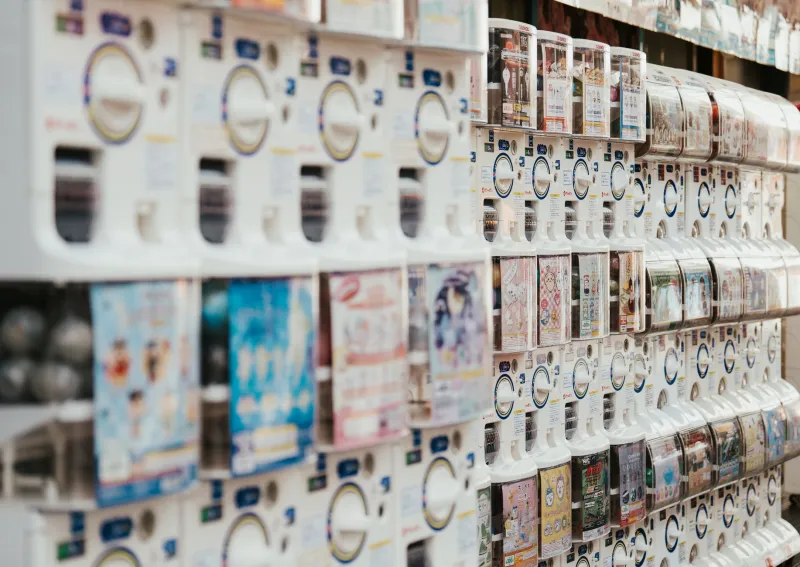
There's a vending machine near the exit of a Japanese grocery store in Little Tokyo, Los Angeles, that doesn't sell chips or soda. It sells tiny plastic dinosaurs with fold-out anatomical diagrams. It sells miniature circuit board models that actually connect. It sells scale reproductions of deep-sea creatures accurate enough to make a marine biologist do a double-take. And every single one of them costs less than four dollars.
Most American parents walking past that machine see a novelty. A handful of educators see something else entirely: a delivery mechanism for the kind of hands-on, curiosity-driven learning that classrooms have been struggling to replicate for years.
What's Actually Inside That Capsule
Japanese gashapon culture — the coin-operated toy vending tradition that's been running since the 1960s — has always had a reputation for surprising detail. But over the last decade or so, manufacturers like Kaiyodo, Bandai, and Takara Tomy have pushed that detail into genuinely educational territory.
Take Kaiyodo's Choco Egg and Capsule Q Museum lines. These aren't just cute animal figures. Many come packaged with species information cards, habitat maps, and size-comparison charts. The Revoltech anatomy series breaks down skeletal structures in ways that rival classroom models costing fifty times as much. There are gashapon series dedicated to famous scientific instruments, geological cross-sections, Japanese hiragana characters, and even the internal workings of mechanical watches.
The learning isn't labeled. It isn't marketed as educational. It's just... there, tucked inside the excitement of the reveal.
"That's the whole trick," says Maya Chen, a third-grade teacher in Austin, Texas, who started incorporating Japanese blind box toys into her science corner two years ago. "The moment you put the word 'educational' on something, half the kids mentally check out. But hand them a capsule with a mystery creature inside and suddenly they're reading the information card without being asked. They want to know."
The Psychology of the Reveal
Child development researchers have a term for what happens when a kid cracks open a blind box: discovery-based engagement. It's the same neurological reward loop that makes foraging feel satisfying, that makes finding a shell on a beach more meaningful than buying one at a gift shop. The uncertainty is the point.
Japanese toy designers appear to have understood this intuitively long before Western edtech companies started building "surprise" mechanics into apps. The randomness of gashapon isn't a bug in the system — it's the feature that keeps kids coming back, comparing what they got, trading duplicates, and researching what they're still missing.
Dr. James Okafor, a learning psychologist based in Chicago who consults for several American school districts, points out that this mirrors established pedagogical thinking. "Self-directed curiosity is one of the most powerful learning accelerators we know of. When a child decides they want to know something — not because a teacher assigned it, but because they genuinely need to know it to make sense of something they're holding in their hands — the retention rate is dramatically higher."
He's seen this play out with Japanese toy sets in after-school programs. Kids who wouldn't voluntarily read a science worksheet will spend twenty minutes cross-referencing their gashapon deep-sea fish against online databases, trying to identify whether their figure is an anglerfish or a viperfish. "That's research," Okafor says. "We just don't call it that because nobody assigned it."
The American Classroom Problem These Toys Accidentally Solve
American education has been wrestling with a stubborn paradox: kids have more access to information than any generation in history, and engagement with formal learning keeps dropping. Screen fatigue is real. Gamified apps that promise to teach math through cartoon characters have had mixed results at best. And physical, tactile learning materials — the kind that actually put something in a child's hands — often get cut first when school budgets tighten.
Japanese capsule toys occupy a strange and useful gap. They're physical. They're affordable. They're driven by intrinsic motivation rather than external reward. And because they're designed for mass commercial appeal in Japan — not specifically for American classrooms — they carry none of the "this is medicine" energy that makes kids suspicious of anything labeled "learning."
Several homeschooling communities across the US have quietly built entire unit studies around Japanese toy series. One popular approach involves using Bandai's Human Body gashapon set — which produces detailed, interlocking models of organs and skeletal components — as the anchor for a biology module. Parents report that kids who handled those models retained anatomical vocabulary significantly better than peers who only used textbooks or videos.
"My daughter can name every bone in the hand," says Priya Nambiar, a homeschooling parent in Seattle. "Not because I drilled her. Because she spent three weeks trying to complete her skeleton figure set and kept asking me what each piece was called."
The 300-Yen Question
Here's where it gets complicated. Not everyone is ready to celebrate the gashapon as an educational tool.
Some child psychologists flag the collection mechanic itself as a concern. The same variable-reward loop that drives curiosity can also fuel compulsive spending behavior, especially in kids who fixate on completing sets. Parents have reported spending significantly more than intended chasing duplicate capsules, and the frustration of repeated pulls can tip from motivating to distressing depending on the child.
There's also the question of access. A machine in a specialty grocery store in a major city isn't reaching rural kids or families in food deserts. The learning potential is real, but it's unevenly distributed in a way that mirrors broader educational inequity.
And then there's the content itself. Not every Japanese capsule toy carries educational value — plenty are pure novelty, designed to be charming and nothing more. The trick for parents and educators is learning to distinguish the series with genuine depth from the ones that are just... cute plastic lumps.
Maya Chen has developed what she calls a "card test." If the toy comes with a printed information insert of any kind, it's worth investigating. "The manufacturers who care about accuracy include documentation. That's your signal."
Play as a Delivery System
What makes this whole conversation interesting from a cultural standpoint is what it reveals about different assumptions around play and learning.
American education culture has historically drawn a fairly sharp line between the two. Play is what you do at recess. Learning is what you do in your seat. Japanese play culture — the tradition that Asobi Lab Billion exists to explore — has never been quite so binary. The word asobi itself encompasses play, leisure, and creative exploration in ways that don't neatly separate "fun" from "growth."
The gashapon toy, in this light, isn't a sneaky educational tool. It's just a product designed within a culture that never fully compartmentalized curiosity from commerce, or play from learning. The fact that it works as a teaching mechanism almost feels like a side effect of that philosophy rather than a calculated design choice.
Which might be exactly why it works so well. The moment learning stops performing as learning, kids stop performing resistance to it.
Somewhere in a Little Tokyo vending machine, a kid is turning a plastic anglerfish over in their hands, squinting at the information card, and already planning to look it up when they get home. Nobody told them to. Nobody gave them a grade for it.
That might be the whole lesson right there.