No Boss Fights Required: The Iyashikei Game Revolution Changing How Americans Think About Play
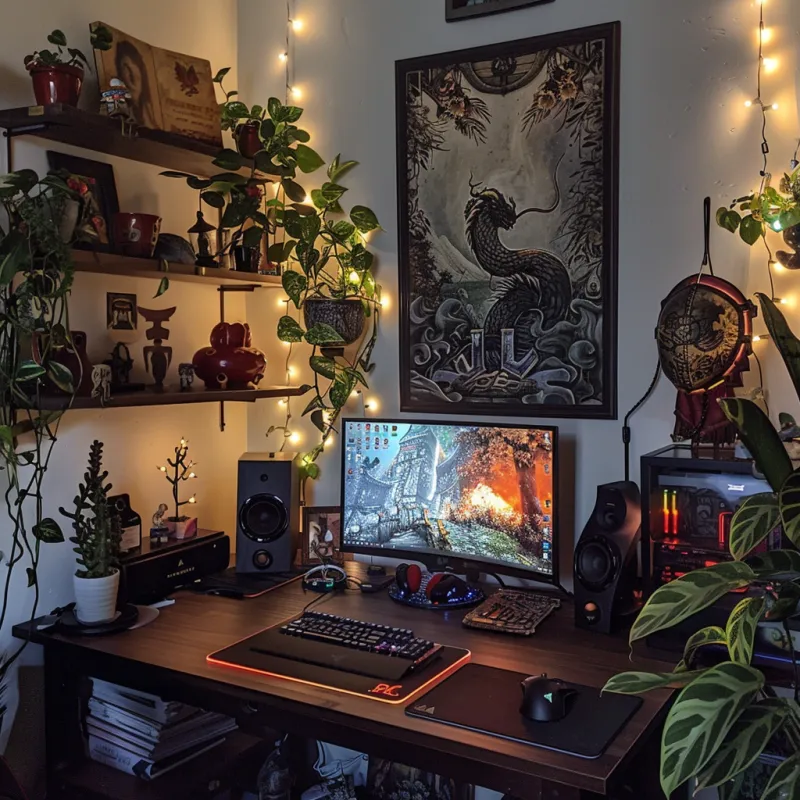
Photo: peaceful cozy gaming setup soft lighting plants controller on couch, via i.pinimg.com
Picture the average American gaming session as the industry has traditionally imagined it: high-octane, competitive, goal-driven. A player hunched forward, reflexes sharpened, chasing the next rank, the next drop, the next dopamine hit from an enemy eliminated. That image has driven billions in development budgets and dominated gaming culture for decades.
Now picture this instead: a player reclined on a couch, controller loose in their hands, wandering through a sun-dappled forest with no objective marker, no timer, no threat. Just the sound of wind through procedurally generated leaves and the low, unhurried satisfaction of existing somewhere gentle.
That second image is increasingly what gaming looks like for a significant and growing slice of the American market — and it has a name that most Western players couldn't have pronounced five years ago.
What Iyashikei Actually Means
Iyashikei (癒し系) is a Japanese term that translates roughly to "healing type" or "soothing type." It originated as a descriptor for a specific style of anime and manga — slice-of-life stories with no dramatic conflict, no villain, no arc toward triumph. Just characters existing in gentle, beautiful worlds where the most stressful thing that happens is deciding what to cook for dinner.
Shows like Non Non Biyori, Aria, and Yotsuba&! built devoted followings precisely because they offered something rare in storytelling: the absence of stakes. No one was going to die. No relationship was going to implode. You could just... be there with the characters, in the warmth of an ordinary afternoon.
That sensibility has now fully migrated into gaming, and the results are disrupting an industry that built its entire identity around challenge, mastery, and competition.
The Games Leading the Shift
To understand what iyashikei gaming looks like in practice, you have to look at a specific cluster of titles that have exploded in popularity with American audiences — often to the surprise of publishers who didn't expect them to travel.
Alba: A Wildlife Adventure gives you a camera and asks you to photograph birds. Flower and Journey, both from thatgamecompany, were early Western interpretations of the philosophy — wordless, sensory, deeply Japanese in influence. Spiritfarer wraps a grief narrative in the softest possible game mechanics. A Short Hike is exactly what it sounds like, and players describe it with the kind of warmth usually reserved for childhood memories.
Then there's the broader ecosystem of games directly developed or inspired by Japanese studios: Neko Atsume (a mobile game where you literally just leave food out for cats and check back to see which ones visited), various Yokai Watch spin-offs, and the relentlessly cozy Sakuna: Of Rice and Fire, which treats rice farming as a meditative practice worthy of genuine depth.
What these titles share isn't a genre in the traditional sense. It's an intention. They are designed, from the ground up, to feel safe.
Developers Are Paying Attention
The commercial signals are impossible to ignore. Wholesome Games — a showcase dedicated exclusively to cozy and iyashikei-adjacent titles — has grown from a small Twitter thread into a major industry event with hundreds of game announcements and millions of viewers. Publishers who once dismissed the genre as a niche are now actively acquiring studios that specialize in it.
Developers who work in this space talk about the design process in ways that sound almost therapeutic themselves. The goal isn't to create tension and release it — the traditional game design loop. The goal is to eliminate tension as the primary driver entirely and replace it with something else: curiosity, sensory pleasure, the quiet satisfaction of a world that responds to your presence without punishing your mistakes.
"When you remove failure as a mechanic, you have to find something else to make the player feel like they're doing something meaningful," one indie developer working on a iyashikei-inspired title told us. "That's actually a harder design problem than making a good combat system. But when you solve it, the emotional connection players form with the game is unlike anything else."
For American studios, this represents a genuine philosophical challenge. Western game design culture has been built on the assumption that difficulty equals depth. Iyashikei games argue the opposite: that accessibility and emotional safety can create experiences just as rich, just as memorable, and arguably more lasting.
Mental Wellness Enters the Conversation
Something interesting happens when you start reading player reviews for iyashikei games on platforms like Steam or the App Store. The language shifts. Players don't talk about whether the game is "fun" in the traditional sense. They talk about how it made them feel.
"I play this when my anxiety is bad and it genuinely helps." "This is the only game I can play after a hard day at work." "My therapist actually recommended I try something like this."
That last one is becoming less unusual. Mental health professionals in the US are increasingly aware of the potential therapeutic applications of low-stakes, sensory-rich gaming experiences, particularly for patients dealing with anxiety, depression, or burnout. The research is still early, but the anecdotal evidence from players is overwhelming in its consistency.
This is where the iyashikei philosophy intersects with a very specific American cultural moment. Burnout is no longer a fringe experience — it's a defining condition of contemporary American life across age groups and income levels. Traditional gaming, with its emphasis on performance and competition, can actually exacerbate that feeling for many players. A game that demands you get better, rank higher, and optimize faster is just another form of the pressure people are trying to escape.
Iyashikei games offer something different: a space where showing up is enough.
Redefining the Win State
Perhaps the most profound disruption this movement represents is conceptual rather than commercial. American gaming culture has always been organized around the idea of winning. You finish the game. You beat the score. You reach the top rank. Progress is linear, outcomes are measurable, and success is legible.
Iyashikei games don't have a win state in that sense. You don't finish Neko Atsume — you just keep leaving out food and watching the cats come and go. You don't complete a Journey playthrough in a way that "counts" more than any other. The experience is the point. The wandering is the destination.
For players raised on achievement culture — both inside and outside of games — this can initially feel uncomfortable. What's the point if you're not working toward something? But that discomfort is, arguably, exactly the thing these games are designed to address. Learning to be present in an experience without extracting maximum value from it is a skill that American culture has systematically devalued. Iyashikei games are teaching it back, one soft afternoon at a time.
At Asobi Lab Billion, we think this is one of the most genuinely interesting cultural exchanges happening in digital entertainment right now. Japan has spent decades developing a sophisticated vocabulary for rest, healing, and the value of the uneventful. That vocabulary is arriving in American homes through a controller and a screen, and it's changing what a generation of players believes gaming is actually for.
No boss fight required. No leaderboard. No grind.
Just the quiet, radical act of playing without needing to win.