Close Your Eyes and Play: How Japan's Audio-First Games Are Giving Screen-Fried Americans a Way Back In
There's a specific kind of tired that Americans know really well right now. It's not the kind that a nap fixes. It's the behind-the-eyes, can't-look-at-another-screen exhaustion that hits somewhere around 8 PM when you realize you've been staring at glowing rectangles for fourteen straight hours. Work monitor. Phone. Laptop. TV. Repeat.
And yet — somehow — you still want to play something.
Japanese game developers, it turns out, have been quietly solving this exact problem for decades. They just didn't know it would eventually matter so much to burned-out Americans.
The Genre That Doesn't Need a Screen
Sound novels — a distinctly Japanese genre that blends prose fiction with atmospheric audio design — have existed since the early 1990s. Games like Banshee's Last Cry (a localized version of the cult classic Kamaitachi no Yoru) built entire horror experiences around sparse visuals and immersive sound layering. The idea was never that the graphics were bad — it was that they were intentionally minimal. The sound was doing the heavy lifting.
Fast forward thirty years, and that philosophy has quietly evolved into something far more sophisticated. Japanese studios are now producing experiences that lean almost entirely on spatial audio, voice performance, and sound-as-navigation to create immersive play. Some of these games can be experienced with your eyes literally closed. That's not a bug. That's the whole point.
For American players who've grown up in a gaming culture obsessed with 4K resolution, HDR displays, and visual fidelity benchmarks, this sounds almost countercultural. And honestly? It kind of is.
What Spatial Audio Actually Does to Your Brain
Here's the thing about sound that visual media tends to make us forget: your ears are always on. You can close your eyes. You can look away. But your auditory system keeps processing the environment around you even when you're asleep. It's wired for survival in a way that vision isn't.
Japanese sound designers have understood this for a long time. Games like Otomedius and the broader tradition of otoge (音ゲー, sound games) built entire mechanics around listening as an active skill. But the newer wave of audio-first experiences goes further — using binaural recording techniques and 3D soundscapes to place the player inside a world they never have to see.
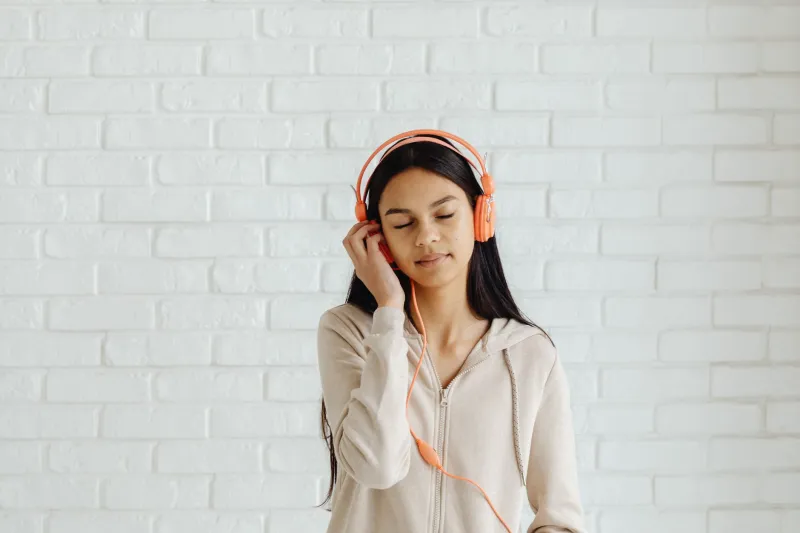
The result is something that feels less like gaming and more like vivid, interactive dreaming. Your brain fills in the visuals. Your imagination does the rendering. And unlike staring at a screen, this process tends to feel restorative rather than draining.
American audio drama and podcast culture has been flirting with this idea for years — but it took Japanese game design sensibilities to actually gamify it.
From Niche to Necessary
It would be easy to write off audio-first gaming as a niche curiosity. But look at what's actually happening in the American market and the timing starts to feel less like coincidence.
Screen time among American adults hit record highs during the pandemic years and hasn't meaningfully come back down. Optometrists are reporting surges in complaints related to digital eye strain. Meanwhile, the meditation app industry — which is fundamentally about not looking at things — has exploded into a multi-billion-dollar space. Americans are clearly hungry for engagement that doesn't punish their eyeballs.
Into this gap steps the audio game. Not podcasts (passive). Not audiobooks (also passive). Something that requires your attention, your decisions, your participation — but gives your visual system a genuine rest.
Japanese developers have a head start here that most American studios don't fully appreciate yet. The tradition of sound novel, the culture of radio drama (rajio dorama), and the long history of audio-centric handheld gaming have created a design vocabulary that translates surprisingly well to the current American moment.
The Accessibility Angle Nobody's Talking About Enough
There's another dimension to this that deserves more airtime: audio-first games are genuinely more accessible to a huge swath of players that visual-heavy gaming frequently excludes.
Americans with visual impairments represent a significant and chronically underserved gaming audience. But even beyond that population, think about the situations where screen gaming just doesn't work — commuting on a packed subway, lying down with a migraine, resting during a lunch break in a bright office. Audio-first experiences slot into all of these moments in ways that traditional games simply can't.
Japanese developers have been particularly thoughtful about this. Games built around sound navigation don't just accommodate non-visual play — they're designed for it from the ground up. That's a fundamentally different approach than slapping a screen reader onto an existing interface and calling it accessible.
For American game studios watching where the market is heading, this is a design philosophy worth studying seriously.
What Playing in the Dark Actually Feels Like
If you've never tried a sound-first game, the experience is genuinely disorienting at first — in the best way. Without a screen to anchor you, your brain has to work differently. You start paying attention to things you'd normally tune out: the direction a sound is coming from, the emotional texture of a voice performance, the way silence functions as punctuation.
Players who've spent time with Japanese audio adventures often describe the experience as weirdly present in a way that visually dense games aren't. There's something about removing the image that forces you to actually listen — not just to the game, but to your own reactions to it.
That's a pretty radical thing for a game to do. And it's a very Japanese idea: that restraint can be a form of intensity. That taking something away can make the experience more, not less.
Where This Goes Next
The honest answer is that audio-first gaming is still pretty underground in the US. It doesn't have a major platform push behind it. It doesn't have a genre label that casual players would recognize at a GameStop (if GameStops still existed, anyway).
But the conditions for it to break through are basically all in place. Wireless earbuds are ubiquitous. Spatial audio is now a standard feature on mainstream headphones. American players are more openly burned out on visual stimulation than they've ever been. And a growing audience is actively looking for gaming experiences that feel different — not just graphically upgraded versions of the same thing.
Japanese sound design culture has been building toward this moment for thirty years. America is just now catching up to needing it.
Close your eyes. Press play. See what happens.